
Quick answer · the 30-second read
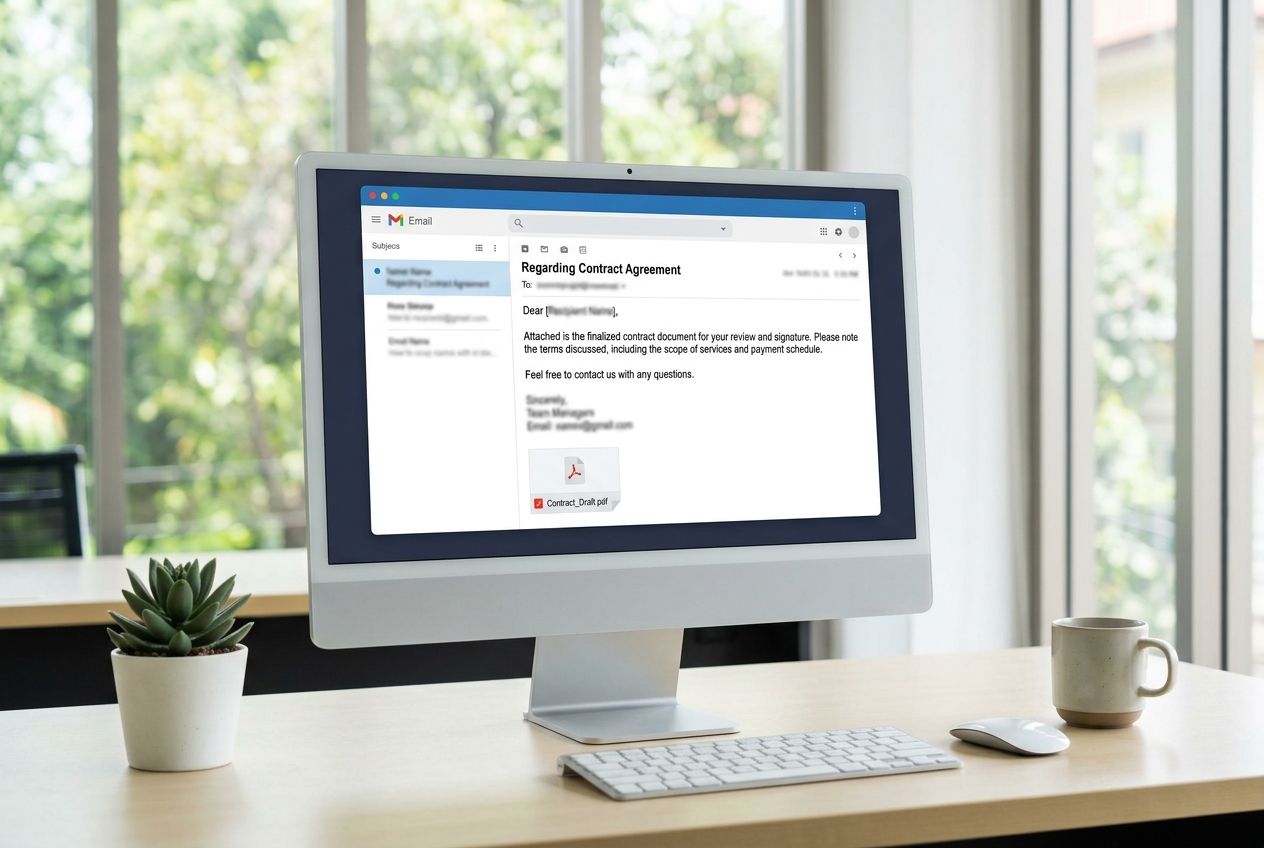
An email signature can help make a contract binding, but it does not create a contract by itself. For most contracts, no signature is needed. An email exchange can become binding when it shows that the parties have agreed clear terms and intend to be legally bound. Some transactions must be recorded in signed writing. In those cases, a name typed at the end of an email can count as the signature. A first name, initials or an automatic email footer may be enough. The sender’s address appearing automatically in the “From” field is unlikely to be enough on its own. To keep email negotiations non-binding, state clearly that they are “subject to contract”.
KEY FACTS
|
Do most contracts need a signature at all?
No, most contracts in England and Wales do not have to be signed, and many do not have to be written down.
A contract forms when one side makes an offer, the other accepts it, something of value passes each way, and both intend to be legally bound. A signature is one way of showing agreement. It is not the thing that creates the contract.
So a deal agreed over a phone call can bind you. So can one agreed across a few emails. The signature question only becomes important where a particular law requires one.
When does an email exchange become binding?
When it shows that both sides have agreed the terms and meant to commit.
What tends to make an exchange binding is specificity. Prices, dates, quantities and scope, followed by a clear acceptance. An email saying that all sounds good, let us go ahead on those terms is much closer to a contract than one saying that looks interesting, send me a proposal.
People often assume negotiations stay safe until a formal document is signed. That is not how it works. If the emails already contain the agreement, the later document may just record something that already exists.
Which documents actually need a signature?
A small number, where a statute requires signed writing.
The main examples are contracts for the sale of land, which must be in writing, contain all the agreed terms and be signed by each party, and guarantees, where one person promises to answer for another’s debt. Deeds are separate again and have their own rules. See What documents cannot be signed electronically?.
For everything else, the signature is useful evidence rather than a legal requirement. It shows who agreed and when, which is worth having even where nothing demands it.
Does a name typed at the end of an email count as a signature?
It can, and the Law Commission has confirmed this.
Its 2019 report on the electronic execution of documents states that a person may type their name, initials or another identifier at the bottom of an electronic document, such as an email, as a way of signing it.
The report goes further. It records the Commission’s earlier view that a system set up to add a name or initials automatically could also provide an electronic signature. So a footer you configured once and no longer think about may still be capable of signing.
What appears at the end of the email | Can it be a signature? |
Your full name, typed by you. | Yes. The clearest case. |
Just your first name, or your initials. | Yes, if you meant it to stand for your agreement. |
A footer your email program adds automatically, which you set up. | Yes, potentially. The Law Commission has said an automatic system can provide an electronic signature. |
Your email address in the From field, filled in by the system. | Unlikely on its own. A court has held that a name inserted this way was not a signature, because there was nothing to show the sender meant it as one. |
Why does the From field not count?
Because nobody chose it.
The Law Commission describes a case where a person’s name appeared in an email address that had been inserted automatically by their internet provider. The court held it was not a signature, because there was no evidence the person intended it to authenticate the document.
A footer you set up is something you decided to attach to your messages. An address the system fills in is just how email works. The first can show intention. The second, on its own, usually cannot.
How do you keep an email exchange non-binding?
Say so in the email, in the part people read.
The standard wording is subject to contract. It tells the other side that nothing is agreed until a formal document is completed, and it is well understood in business and in the courts. Put it in the body, or in the subject line, at the start of a negotiation.
Do not rely on the disclaimer at the bottom of your emails. A footer saying nothing in this message creates a contract carries very little weight against a message that reads like an agreement. See Do email disclaimers have any legal effect?.
Be careful with words like 'agreed', 'confirmed' and 'accepted' while terms are still being discussed. And if someone sends you something that reads like acceptance and you did not mean to agree, say so at once rather than letting it sit.
What does this mean in practice?
Assume your emails can bind you, and write accordingly.
If you are negotiating, use subject to contract until you are ready. If you are ready to commit, say so clearly, because ambiguity helps nobody. And if the deal is one that needs signed writing, such as anything involving land, use a proper document rather than relying on an email exchange.
For higher value agreements, a signing platform gives you something an email cannot, which is a record of who signed, when and from where. See What is an audit trail for e-signatures?.
Sources
- Law Commission, Electronic Execution of Documents (Law Com No 386, 2019), paragraphs 2.6, 2.7 and 3.54 lawcom.gov.uk/project/electronic-execution-of-documents Accessed 18 October 2026
- Law of Property (Miscellaneous Provisions) Act 1989, section 2 legislation.gov.uk/ukpga/1989/34/section/2 Accessed 18 October 2026
- Statute of Frauds 1677, section 4, guarantees legislation.gov.uk/aep/Cha2/29/3/section/IV Accessed 18 October 2026
- Electronic Communications Act 2000, section 7 legislation.gov.uk/ukpga/2000/7/section/7 Accessed 18 October 2026


