
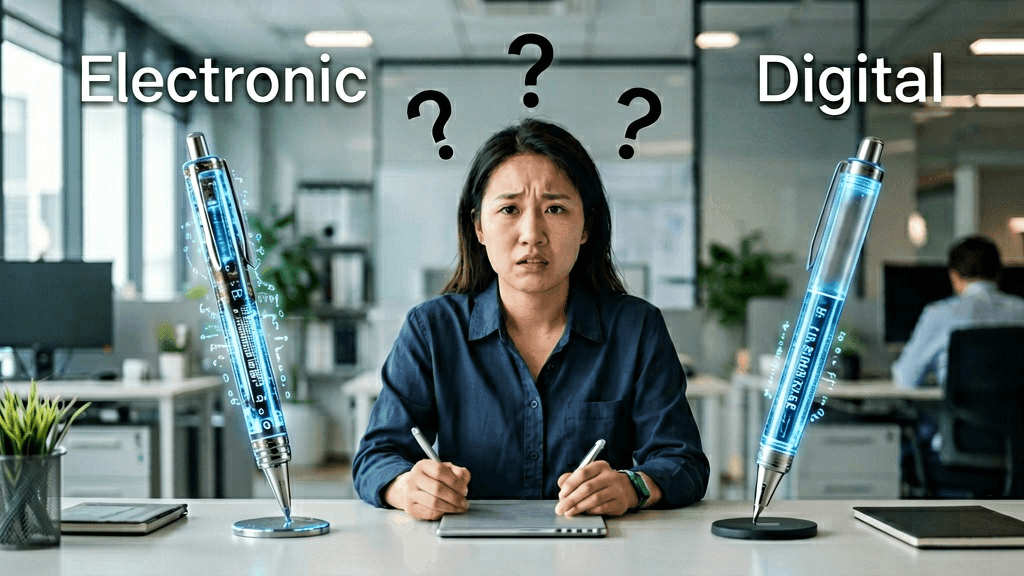
Quick answer · the 30-second read
An electronic signature is any digital way of signing. A digital signature is a more secure type that proves who signed and shows if the document has been changed.
Electronic signatures and digital signatures are not the same thing, even though the terms are often used interchangeably. Understanding the difference helps you choose the right method for what you are signing.
An electronic signature is the broad term. It covers anything electronic you do to indicate you are signing — typing your name, clicking ‘I agree’, or drawing a squiggle on a screen. These are all electronic signatures, and they are all legally valid for most documents.
A digital signature is a specific, more secure type of electronic signature. It uses technology to do two things an ordinary electronic signature cannot: prove exactly who signed, and detect whether the document has been altered since. If someone changes even a single word after you sign, the signature automatically shows as invalid.
For most everyday documents, an electronic signature is all you need. For high-value contracts, property transactions, or anything where a dispute is likely, a digital signature gives you much stronger protection.
A side by side comparison
Electronic signature | Digital signature | |
|---|---|---|
What it is | Any electronic way of indicating you intend to sign | A secure type of electronic signature with identity verification and tamper detection |
Examples | Typed name, tick-box, drawn squiggle, scanned handwritten signature | Signature created by a signing platform, backed by a verified certificate |
Proves who signed? | Not automatically. Relies on surrounding evidence | Yes. Tied to a certificate that verifies the signer’s identity |
Detects changes? | No. A document can be altered without the signature showing it | Yes. Any change after signing makes the signature invalid |
Legally valid? | Yes, for most documents in the UK, US, and EU | Yes. At the highest level, carries the same weight as a handwritten signature in law |
Needs a platform? | No. Typing a name or clicking a button needs nothing special | Yes. Requires a signing service to manage the certificate |
Creates an audit trail? | Only if you use a dedicated signing platform | Yes. Automatically records who signed, when, and on which device |
Typical use | Everyday contracts, HR documents, supplier agreements, approvals | Property deeds, high-value contracts, regulated documents, cross-border transactions |
Basic Questions
Are they both legal?
Yes. Both are legally recognised in the UK, the US, and across the EU. Neither can be rejected simply because it is electronic rather than handwritten. The law treats them as valid ways to sign for the vast majority of documents.
The difference is not whether they are legal, it is how easy they are to challenge. A typed name can be disputed because anyone could have typed it. A digital signature is much harder to dispute because it is automatically tied to a verified identity and shows if the document has been changed.
Which one should I use?
For most everyday documents, such as employment contracts, supplier agreements, approvals, and non-disclosure agreements, a standard electronic signature is fine. You do not need anything more.
Choose a digital signature when:
- The contract is high value and a dispute would be costly
- You need to prove exactly who signed, not just that a name appears on a document
- The document involves property, a regulated transaction, or a government body
- The other party or your organisation requires a higher level of assurance
If you are unsure, a digital signature is never the wrong choice. It provides everything an electronic signature does, plus more.
Can I use them on the same document?
In most cases, yes. Different parties can sign the same document in different ways, and each signature is valid for that person regardless of how others signed.
The main exception is property deeds submitted to HM Land Registry. For those, the signatory and their witness must both use the same method through the same platform. Mixing methods on a deed is not accepted.
Is one more expensive than the other?
A basic electronic signature costs nothing. Typing your name or clicking a button requires no software or subscription. A digital signature requires a platform or service, which typically charges a subscription or a per-document fee.
In the EU, a change coming into effect by end of 2026 will make qualified digital signatures available free of charge to individual citizens for personal use through a new EU Digital Identity Wallet. This does not apply to the UK.
Going Deeper
What makes a digital signature more secure?
When you apply a digital signature, the software takes a snapshot of the document at that exact moment. It's a unique fingerprint. That fingerprint is locked to your verified identity. Anyone who opens the document later can check that the fingerprint still matches. If the document has been changed in any way, the fingerprint no longer matches and the signature shows as invalid.
An ordinary electronic signature does not do this. A typed name or a drawn squiggle confirms that someone intended to sign, but it does not prove who they were, and it does not detect changes. The document could be altered after signing with no visible sign that anything happened.
What is a qualified electronic signature and where does it fit?
A qualified electronic signature is the highest legal tier of digital signature. It is backed by a certificate from a government-approved authority, and in law it carries exactly the same weight as a handwritten signature. It cannot be rejected simply because it is electronic.
Getting a qualified certificate requires verified identity checks, the kind you go through when opening a bank account. This is what makes it the most trustworthy option. Most people do not need a qualified signature for everyday documents. It is typically used for high-value or regulated transactions, or where the law specifically requires it.
Below that sits an advanced electronic signature. It is still a digital signature, still tied to your identity and tamper-evident, but backed by a less stringent certificate. Most reputable e-signature platforms issue advanced signatures. These are sufficient for the vast majority of business contracts.
What about property documents?
Property deeds are treated differently from most documents. In England and Wales, a deed must be signed in the physical presence of a witness. This applies whether you sign electronically or in ink.
HM Land Registry accepts two methods for electronically processed deeds (set out in Practice Guide 82, updated 7 July 2025). A Mercury signature is where you sign a printed page in wet ink in front of a witness, then scan it. A Conveyancer-Certified Electronic Signature (CCES) is where you sign through a platform, again in the physical presence of a witness. Your conveyancer manages either process.
HMLR is also piloting a scheme accepting qualified digital signatures for certain transactions. In all cases, the applications must be submitted electronically.
Does it matter which I use in Scotland?
For most commercial contracts in Scotland, no. Both work fine. The difference becomes significant for formal documents.
In Scotland, a document that carries a qualified digital signature is ‘self-proving’. A court presumes it is valid without needing further evidence. A document with a standard advanced digital signature does not have this status, though it still satisfies the formal signing requirement. A simple electronic signature such as a typed name does not satisfy formal requirements at all for documents that must be executed under Scottish law.
How do I check whether a digital signature is genuine?
You usually do not need to do anything. Most PDF readers, including Adobe Acrobat Reader, which is free, check digital signatures automatically when you open the document. They display whether the signature is valid, when it was applied, and whether the document has been changed since signing.
A simple electronic signature gives you none of this. If someone disputes a typed name, you are relying on emails, timestamps, and context rather than an automatic verification built into the document itself. That is the practical difference in the event of a dispute.
What is the position in the US?
Both types are legally valid across the US under federal law (the ESIGN Act 2000) and under state-level laws adopted by 49 states. Neither can be rejected solely because it is electronic.
The US does not use the EU’s three-tier system of simple, advanced, and qualified signatures. Instead, US law focuses on intent and the reliability of the signing method. In practice, a digital signature from a reputable platform provides the strongest evidentiary position. For documents with specific state-law requirements, it is worth checking the rules for that state.
Legislative references
Every factual claim on this page traces to one of the following primary sources.
UK
Electronic Communications Act 2000 (c. 7), s. 7 - makes electronic signatures admissible as evidence in UK proceedings. legislation.gov.uk/ukpga/2000/7
Electronic Identification and Trust Services for Electronic Transactions Regulations 2016 (SI 2016/696) - brings the eIDAS framework into UK law. legislation.gov.uk/uksi/2016/696
Requirements of Writing (Scotland) Act 1995; Electronic Documents (Scotland) Regulations 2014 (SSI 2014/83) - authentication and self-proving requirements in Scotland. legislation.gov.uk/ssi/2014/83
Law Commission, Electronic Execution of Documents, Law Com No 386 (2019) - confirms all electronic signature types can satisfy statutory signing requirements. lawcom.gov.uk — Electronic Execution of Documents
HM Land Registry, Practice Guide 82 (updated 7 July 2025) - Mercury signatures and CCES; physical witness required; electronic submission required; QES pilot. gov.uk — Practice Guide 82
Data (Use and Access) Act 2025 (c. 18), Part 2 - Digital Verification Services (DVS) framework; OfDIA. In force 1 December 2025. legislation.gov.uk/ukpga/2025/18/part/2
EU
eIDAS Regulation (EU) No 910/2014 - defines the three tiers of electronic signature; Article 25(2): qualified signature has same legal effect as a handwritten signature. eur-lex.europa.eu — CELEX:32014R0910
eIDAS 2.0 (Regulation (EU) 2024/1183, in force 20 May 2024) - mandates EU Digital Identity Wallet by end of 2026. Does not apply to the UK.
US
ESIGN Act 2000, 15 U.S.C. §§ 7001–7031 - electronic and digital signatures legally equivalent to handwritten signatures in interstate and foreign commerce. law.cornell.edu — 15 U.S.C. § 7001
Uniform Electronic Transactions Act (UETA) - adopted by 49 states and the District of Columbia. uniformlaws.org — UETA adoption table
All information on this page was accurate as of May 2026. Produced by Signatures.com, an independent editorial authority. Not legal advice.


