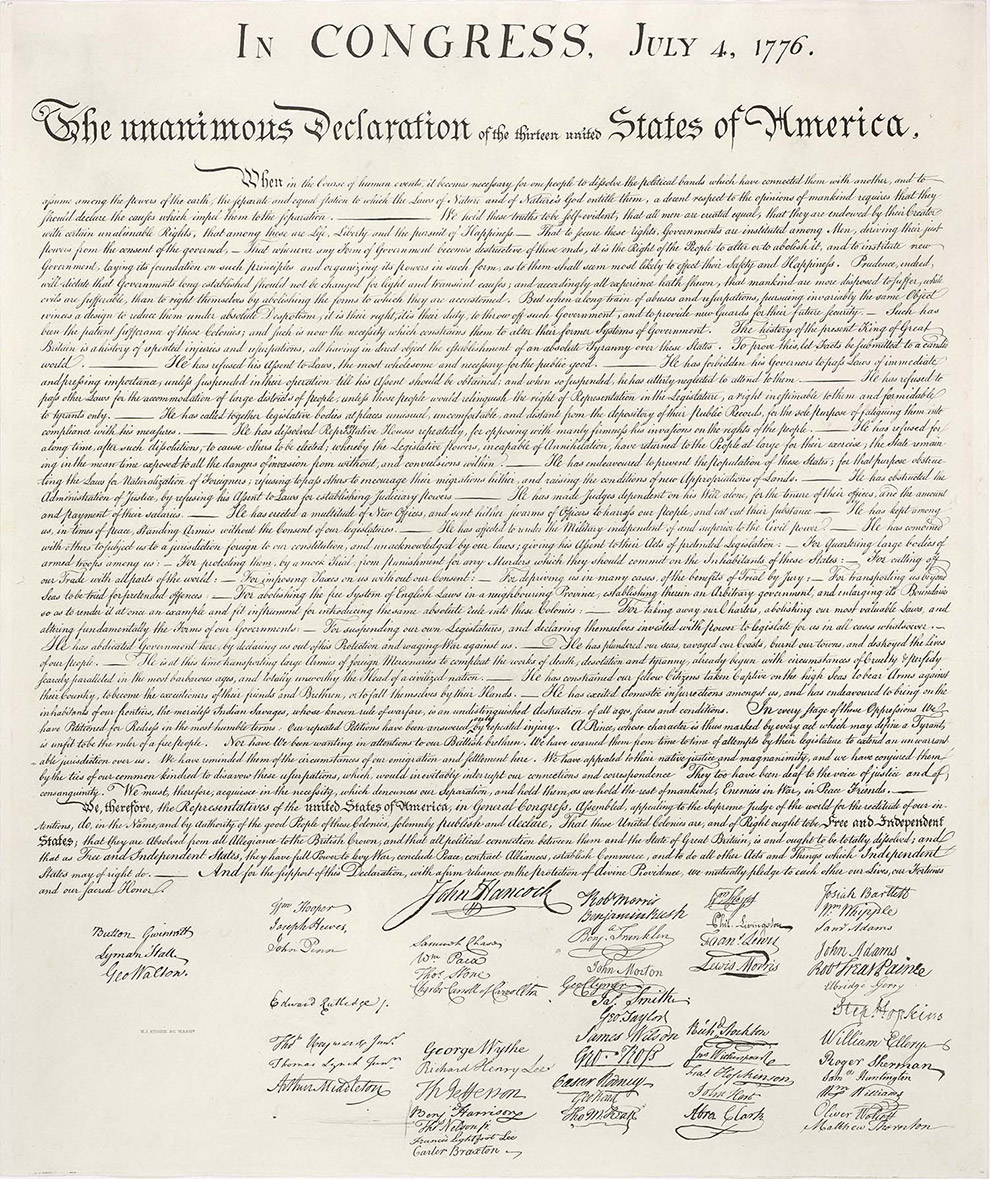
It is the only signature ever to become a word, at least in North America. As the US marks 250 years since the Declaration of Independence, here is the story of the man with the enormous autograph, the famous line he never said, and the woman whose name is on the document but who never signed it.
When John Hancock, president of the Second Continental Congress (a provisional government in the US during the American revolution) signed the US Declaration of Independence in 1776 he clearly wanted to make a statement. His signature, while almost certainly the most famous and important in US history, was also one of the biggest. It measures roughly 4.7 inches wide and 1.3 inches tall, and is the largest of the 56 names by some distance. If all 56 delegates had signed at Hancock’s scale, they would not have fitted on the page.
The reason behind the signature has been debated for years. The legend is that Hancock signed big so that King George III could read it without his spectacles, and stood up to say so. It is a lovely story. It has defiance, and a punchline but it is almost certainly made up. No account from the time records the remark. The earliest versions appeared in print decades later, usually bundled with the claim that Britain had put a price on Hancock’s head too.
So how did the man become the word? Copies of the Declaration spread through the new country, and Hancock’s was apparently the one name anybody could read from across the room. By the mid-1800s, ‘put your John Hancock here’ was everyday American English. Cowboys in the West then somehow turned it into ‘John Henry’, a variant that is still in dictionaries and that nobody has ever satisfactorily explained.
Should July 4th actually be Independence Day?
There is also uncertainty over the signing date of the document. The official record shows most of the 56 delegates signed the parchment on 2 August 1776, a month after Congress adopted the text, with the final names added later still. But Jefferson, Adams and Franklin all insisted, to the ends of their lives, that the Declaration was signed on 4th July. Jefferson went further, claiming a paper copy was signed that day and the parchment then signed again in August. If that paper copy ever existed, it has never been found, and fellow signer Thomas McKean flatly denied the 4th July signing ever happened.
Most historians side with McKean and the record. A few side with Jefferson, including one legal historian who argued in the 1980s that around 34 delegates really did sign on the day. Either way, three Founding Fathers and the man who printed the record could not agree on when the most famous document in American history was signed, which is quite the endorsement for keeping a good audit trail.
One more twist. There is a woman’s name on the Declaration of Independence, and it is the only name on it that was never signed. In January 1777, Congress ordered a new printing that would, for the first time, list the signers publicly, and gave the job to Mary Katharine Goddard, a Baltimore printer, publisher and postmaster, quite possibly the first woman employed by the United States government. At the bottom, where she usually put a discreet ‘M.K. Goddard’, she set her name in full - ‘Baltimore, in Maryland: Printed by Mary Katharine Goddard’. Putting your full, unmistakably female name on a treasonous document was its own act of defiance, arguably braver than Hancock’s, since she was not protected by a fortune. Only nine of her broadsides are known to survive.
Lost and found
The UK, meanwhile, has been sitting on its own copies. The UK National Archives at Kew holds three of the original broadsides printed in Philadelphia in 1776, and this year gained a fourth when a volunteer cataloguing Royal Navy papers found a copy printed in New Hampshire in July 1776. It had been seized on Christmas Eve that year when HMS Raisonable ran down an American ship off Portugal after a seven-hour chase.
The captured papers were shipped to Plymouth, then to Whitehall, where a naval clerk recorded the founding document of the United States as ‘another paper’. There it sat for almost 250 years. It has now been conserved and is going on display in the archives’ Revolution 250 exhibition, the only known copy of the Declaration ever taken by military action.
,_by_John_Trumbull.jpg)
And one final thing. That painting by John Trumbull, called the Declaration of Independence which is hanging in the US Capitol rotunda (based on a smaller version currently held at Yale University Art Gallery), does not actually depict the signing of the document, as is sometimes suggested. It does in fact show the presentation of the draft declaration to Congress in June 1776.
So a story full of intrigue, complication and myth. The quote is invented, the date is disputed, the painting shows a different day, and the most defiant name on the document may belong to the printer. Strip all of that away and one fact is left standing: 250 years on, Americans still call a signature a John Hancock. Nobody has ever needed to fact-check that.
Sources
- US National Archives, Pieces of History: ‘John Hancock and His Signature’
- Journal of the American Revolution: ‘Did John Hancock Really Say That about his Signature?’ (2019)
- Slate: signature measurements from the engrossed copy (2014)
- US National Park Service on Mary Katharine Goddard and the Goddard Broadside
- BBC News: rare Declaration of Independence copy found at The National Archives, Kew (2026)
- The National Archives (UK), Revolution 250: America’s Independence Story exhibition
- Harvard Declaration Resources Project on the signing date dispute