
Quick answer · the 30-second read
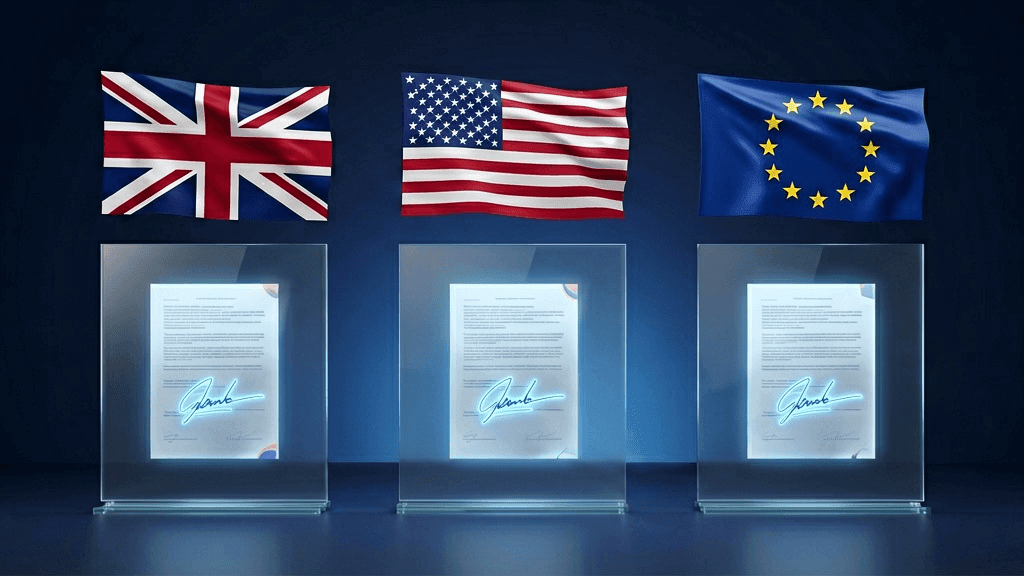
Yes. Electronic signatures are legally binding in the UK, the US, and across the EU for the vast majority of documents. In the UK, the Electronic Communications Act 2000 makes clear that a signature cannot be denied legal effect solely because it is electronic. The same principle applies in the US under the ESIGN Act 2000 and in the EU under the eIDAS Regulation. None of these laws treat a handwritten signature as superior to an electronic one. A small number of document types are excluded from this rule, such as wills in England and Wales being the most commonly encountered. For everything else, an electronic signature carries the same legal weight as ink on paper.
The question of whether an electronic signature is legally binding is really a question about intent. The law does not require a specific technology or a specific appearance. What it requires is that the person signing intended to sign. Clicking a button, typing a name, or drawing a squiggle on a screen all demonstrate that intent, provided the context makes clear what the person was agreeing to.
The strength of an electronic signature varies by method. A typed name on an email is legally valid but easier to dispute than a signature generated through a dedicated platform with a full audit trail. A qualified digital signature, backed by a certificate from a government-approved authority, is the hardest of all to challenge and carries an explicit legal guarantee of equivalence to a handwritten signature. But all of them are binding.
The exceptions are important. A handful of document types, such as wills, statutory declarations, and a small number of others, still require a wet-ink signature under specific legislation. For those documents, the general rule does not apply. Outside those exceptions, electronic signatures are fully enforceable.
The legal position by jurisdiction
The core rule is the same in all three jurisdictions: electronic signatures are valid. The detail differs.
UK | US | EU | |
|---|---|---|---|
Primary law | Electronic Communications Act 2000, s. 7 | ESIGN Act 2000 (15 U.S.C. § 7001) | eIDAS Regulation (EU) No 910/2014 |
Core rule | Cannot be denied legal effect solely because it is electronic | Cannot be denied legal effect solely because it is electronic | Cannot be denied legal effect solely because it is electronic |
Highest tier | Qualified electronic signature - same legal effect as handwritten signature | No formal tier system; courts assess reliability of method used | Qualified electronic signature - same legal effect as handwritten signature (Article 25(2)) |
Key exceptions | Wills, statutory declarations, some court documents | Wills, adoption, divorce, certain consumer notices (s. 7003) | Member states may exclude specific document types |
Enforced by | UK courts; ICO oversees trust services | Federal and state courts; FTC for consumer matters | National supervisory bodies in each member state |
Scotland: a note on self-proving documents
Electronic signatures are legally valid in Scotland under the same broad principles. However, for formal documents, such as those requiring execution under the Requirements of Writing (Scotland) Act 1995, the type of signature matters. A document with a qualified electronic signature is self-proving, meaning a court presumes it is valid without further evidence. A document with an advanced electronic signature satisfies the formal execution requirement but is not self-proving. A simple electronic signature such as a typed name does not satisfy the formal execution requirement for these documents at all.Basic Questions
What makes an electronic signature legally binding?
Two things: intent and context. The person signing must intend to sign, to indicate their agreement or authorisation, and it must be clear from the context what they are agreeing to. A signature applied through a dedicated signing platform satisfies both conditions easily: the signer follows a clear process, is shown the document before signing, and confirms their action deliberately.
A typed name at the bottom of an email can also satisfy both conditions, though it is easier to dispute. The intent is demonstrated by the act of typing; the context is the email exchange and the document attached. Courts look at the full picture, not just the signature itself.
Does it matter which type of electronic signature I use?
For most documents, no. Any electronic signature is binding. What differs is how easy it is to challenge. A simple electronic signature such as a typed name is valid but relies on surrounding evidence if disputed. A platform-generated signature with an audit trail is significantly harder to challenge. A qualified digital signature provides the strongest possible evidence and carries an explicit legal guarantee.
The type starts to matter when a specific standard is required - for example, certain regulated transactions or cross-border EU documents where a qualified electronic signature is specified. For those, a simple typed name would not be sufficient, even though it is technically binding for most other purposes.
Can someone refuse to accept an electronic signature?
Not on legal grounds alone in the UK, US, or EU. The law in all three jurisdictions says explicitly that a signature cannot be refused solely because it is electronic. If someone refuses an electronic signature, they must have a reason beyond the fact that it is not handwritten.
Legitimate reasons to require a different method include: the document type is one of the specific statutory exceptions; a contract between the parties specifies a particular signing method; or a regulator has prescribed a specific standard for that transaction type. Habit or preference is not a legal reason, though in practice you may need to comply to complete the transaction.
Is an electronic signature binding even without a witness?
For most documents, yes. The vast majority of contracts and agreements have no witnessing requirement, whether signed electronically or in ink. No witness is needed for employment contracts, commercial agreements, supplier contracts, or most consumer documents.
The exception is deeds. This includes property transfers and lasting powers of attorney. Both require a witness to be physically present. That witnessing requirement applies regardless of whether the signature is electronic or handwritten. Outside of deeds, witnessing is not a condition of legal validity.
Going Deeper
What happens if someone disputes an electronic signature?
The starting point is that the signature is presumed valid. The person challenging it must produce evidence that it was not genuinely made by the person named, or that the document was altered after signing.
A simple electronic signature - a typed name - is challenged by arguing that the named person did not type it. The response relies on surrounding evidence: email records, timestamps, communications between the parties. A platform-generated signature adds a structured audit trail that is harder to unpick. A qualified digital signature is the most robust: any change to the document after signing invalidates it automatically, and the certificate ties the signature to a verified identity.
In UK courts, electronic signatures are admissible as evidence under the Electronic Communications Act 2000. Courts have consistently treated well-documented electronic signatures as binding. The Law Commission confirmed in its 2019 report (Law Com No 386) that there is no legal barrier to electronic signatures being used to execute most documents, including deeds.
Are electronic signatures binding for consumer contracts?
Yes. Consumer contracts for goods, services, subscriptions, and most other everyday agreements can be signed electronically without restriction in the UK, US, and EU. Clicking ‘I agree’ on a website or app is an electronic signature and creates a binding contract, provided the terms were clearly presented before the click.
In the US, the ESIGN Act specifically addresses consumer contracts and sets out requirements for electronic consent to be valid: the consumer must affirmatively consent to electronic records, must be able to withdraw that consent, and must receive a clear statement of their right to receive paper records. These requirements apply to the delivery of documents rather than to the signature itself, but they are relevant for businesses sending contracts electronically to consumers.
Does the law differ for business-to-business contracts?
The legal position is the same. Electronic signatures are binding. However, the practical considerations differ. Business contracts are more likely to be high value, more likely to be disputed, and more likely to require a specific standard of signature as a matter of commercial practice or contractual specification.
Many businesses now specify in their standard terms what signing method is acceptable. If a contract says it must be signed by a qualified electronic signature or by wet ink, then those terms govern the transaction, not the general rule. A business that signs electronically where the contract specified wet ink may find the signature disputed, even though electronic signatures are generally valid.
What about electronic signatures on contracts governed by foreign law?
If a contract specifies that it is governed by the law of a particular country, the validity of the electronic signature may be assessed under that country’s rules. Most major jurisdictions now recognise electronic signatures, but the specific requirements vary.
For UK businesses signing contracts governed by EU law, the eIDAS framework applies. For contracts governed by US state law, the relevant state’s version of UETA or the ESIGN Act applies. For contracts governed by the law of jurisdictions outside the UK, US, and EU, separate advice is needed. The principle - electronic signatures are generally valid - is widely accepted internationally, but the specifics differ.
Sources
- Electronic Communications Act 2000 (c. 7), s. 7 — electronic signatures admissible as evidence; cannot be denied legal effect solely because electronic. legislation.gov.uk/ukpga/2000/7 Accessed 11 October 2026
- Requirements of Writing (Scotland) Act 1995; Electronic Documents (Scotland) Regulations 2014 (SSI 2014/83) — formal execution in Scotland; self-proving status requires qualified electronic signature. legislation.gov.uk/ssi/2014/83 Accessed 11 October 2026
- Law Commission, Electronic Execution of Documents, Law Com No 386 (2019) — confirms electronic signatures valid for deeds; no legal barrier to electronic execution. lawcom.gov.uk/project/electronic-execution-of-documents Accessed 11 October 2026
- ESIGN Act 2000, 15 U.S.C. §§ 7001–7031 — § 7001(a): general rule of validity; § 7003: specific exclusions; consumer consent requirements. law.cornell.edu/uscode/text/15/chapter-96/subchapter-I Accessed 11 October 2026
- Uniform Electronic Transactions Act (UETA) — adopted by 49 states and the District of Columbia. uniformlaws.org/committees/community-home Accessed 11 October 2026
- eIDAS Regulation (EU) No 910/2014 — Article 25(1): non-discrimination principle; Article 25(2): qualified electronic signature equivalent to handwritten signature. eur-lex.europa.eu/eli/reg/2014/910/oj/eng Accessed 11 October 2026


